
Psychologically Informed Environments (PIE).
'Psychologically Informed Environments (PIE)' is a 6-hour self-paced course from the Association for Psychological Therapies (APT), a leading provider of accredited courses for professionals working in mental health and related areas.
It is the only Psychologically Informed Environments (PIE) training is Delegate–Accredited and uniquely combines built-in APT Registration with automatic access to our renowned post-course resources to help you support your clients. It is available for both teams and individuals.
Course overview:
‘Psychologically Informed Environments’ is a concept that originated in the context of working with marginalised people, especially the homeless, and, because of the importance of the key ideas, it has evolved into something that applies in a very wide range of workplaces, including hospitals, mental health facilities, schools and universities, offices, and more. The key ideas are:
1. Developing ‘a psychological framework’.
In a mental health facility, this might be quite a sophisticated positive approach, such as the RAID philosophy. In an office, it might be to be kind and supportive of each other and yet efficient. In other places, it might be something quite different, and we show you how to identify what might work best for you.
2. The physical environment and social spaces.
Superficially, the design of the physical environment might itself appear to be superficial, but it is not: the physical environment immediately conveys a lot about how the organisation cares for those in it, by its original design and how well or badly it is maintained.
3. Staff training and support.
It is a defining feature of a PIE that staff understand why they are doing what they do and how best to sustain it. Many workplaces can be very demanding, and so a PIE pays attention to staff wellbeing, through reflective practice, supervision, and ongoing development. We look at how to create a culture where staff feel safe, valued and resourced – and therefore are at their best.
4. Managing relationships.
At the heart of any psychologically informed approach is the understanding that relationships are central. So, in a PIE, relationships are handled deliberately rather than by chance. A PIE also pays attention to relationships within the organisation (between colleagues, teams, and management), recognising that modelling respectful, authentic, and restorative relationships is key to achieving them externally.
5. Evaluation of outcomes.
Part of the strength of PIE lies in noticing and understanding what is working and what needs adjusting. That may involve formal outcome measures, qualitative feedback, staff reflection logs, or simply noticing meaningful changes of any sort. A PIE evolves through thoughtful evaluation of these observations, ensuring the environment genuinely supports the people and purpose it is designed to achieve.
So this is what the course covers, with encouragement at each stage for you to apply the concepts to your own workplace, wherever that is.
PIE thinking is not reserved for specialist services; it is a way of understanding how any environment can shape experience, behaviour, and wellbeing. The course equips you to look at your own context with fresh eyes — what is already helpful, what might be refined, and how relevant psychological principles can be made real, practical and supportive day-to-day.
What you receive as a result of attending the training:
You will be registered as having attended the course and receive a certificate of completion. This gives you APT Registration in PIE, and access to the relevant resources to help you implement PIE thinking subsequently.
Booking is easy...
|
|
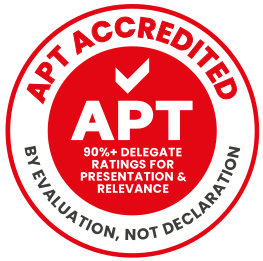

Live Feedback Ratings.
Every delegate rates the course upon completion and the averages below update automatically as each course is completed.
These live results also power APT’s acclaimed Accreditation System — so widely valued because it is evidence-based, drawing directly on the real-time ratings of professionals who have completed the training.
Online Anytime*
Overall Rating:
* Feedback taken from the last 20 people completing the course.

Reviews.
APT prides itself on the feedback we receive about our courses. Below are just some of the great comments APT courses have received.
"An absolutely brilliantly presented course ... I would highly recommend this course to anyone who has client contact. Amazing!"
“I really enjoyed this course, absolutely the most impressive and useful training I have received in the 11 years working for the Trust.”
“Mind blowing training ... How I love training that I can take so much away with me, both for my professional and personal life.”